Showing posts with label Finances. Show all posts

Thursday, August 22, 2019

6 Reasons You Should Be Shopping at Ethnic Stores


For many years I looked at ethnic markets with a degree of trepadition. New situations can be unsettling.

I thought:


  •  the quality of food would be inferior. 
  • the store employees would be unfriendly.
  • I would be unable to understand the native accents of the employees.
  • I would be seen as an interloper, because I was not of their heritage.
  • the prices would be substantially higher than those at traditional stores. 

I was wrong! - very, very wrong!


Here are 6 reasons why I am so glad that I got over my self-imposed fear factor and ventured into
ethnic food stores.


    1.  Your money stays local! 


    Local ethnic markets are often most often owned by people who live, work, and raise their families right in your hometown. They care deeply about creating a friendly atmosphere that keeps you coming back.

    I grew up in a very small town, population 1800.  There was a very real sense of treating your neighbor like they were family. That same feeling exists in ethnic grocery stores. When you shop there, they learn your first name, know what products you like, and give you personal treatment. It's all about relationships!

    In my area, we have a large diversity of ethnic market choices:


    • Mediterranean
    • Mexican
    • Indian
    • Asian

    2. Owners may offer a special case price. 


    I paid $4.00 for the entire case!

    It is not uncommon for ethnic stores to offer customers a discount on the purchase case lots of products. Unlike larger stores, where corporate policy mandates, the extent to which local managers can service customers, at a small grocer, the owner is often the person to whom you are speaking. If they can give you a better deal, they often will.


    A case of red lentils I purchased at a discounted price. 


    On the flip side of the coin, I go out of my way to stop in frequently just to see what my ethnic stores have on hand. I want locally owned stores to stay in business!  

    3. Fresh shipments arrive weekly from big city markets. 


    Organic Parsley and Cilantro for 50¢ a bunch! 

    I became very aware of the time and day of the week that my local stores receive their new shipments of merchandise.

    I know that at around 3pm every Thursday, the Mediterranean Mart will be brimming with brand new merchandise, produce, and fresh flatbreads from Chicago's bakeries and markets.


    The produce is not only fresh, it is often priced less than mass market competitor grocery stores. 


    As a bonus, items left on the shelf from last week may be offered at a discount.


    4. You'll save money! 

    Here are just a few items that I found on the shelves at great prices on a recent visit to Mediterranean Mart. 

    Love this thin, fancy pasta for just $.99! 

    Fresh figs, only available for a short time each year

    Organic hummus, stocked at the request of customers


    Speciality items are often substantially cheaper than the very same item from a traditional grocery store. Regional spices are nearly always less than those from traditional grocers.


    I often get new spices to try, because they are so inexpensive


    The first time I entered the Mediterranean Mart, it was to find garam masala. I needed this savory spice mix for a recipe and had heard from others that one could find spices for great prices at this locally-owned shop.


    Small section of the spice selection at Mediterranean Mart


    Upon entering, I was greeted by the ultra-friendly owner, Sieed immediately showed me the spice section, patiently explaining each specialty blend, giving me ideas on how they were used in his native country. The prices were fabulous and, to a food geek like me, an undeniable bargain.
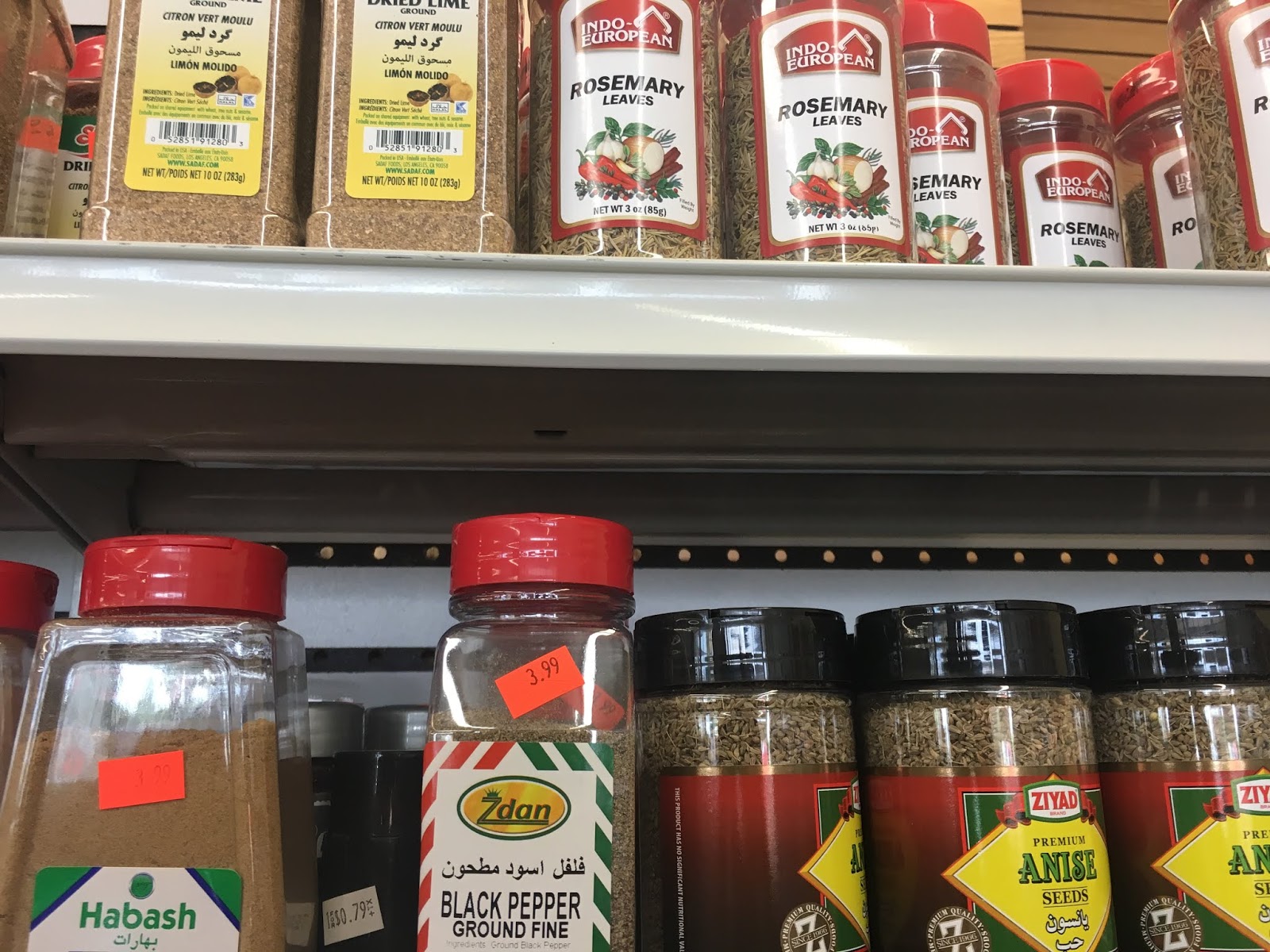

    Some of our favorite shelf stable items from Mediterranean Mart


    Not only did I discover a love for a whole host of Middle Eastern spices, I also found items that are staples in my kitchen.

      5. You just may find some new favorite foods and flavors. 


      I had hardly tasted a red lentil before I started frequenting the Mediterranean Mart. We quickly grew to love their flavor and their ease of preparation.



      Here's a recipe for Mediterranean Red Lentil soup that may quickly become one of your family's most requested meals, too! 


      6. You'll make new friends! 


      Ethnic grocers love to share their knowledge with customers! They will go out of their way to insure that you are happy with your purchase and know how to use it once you get it home. Not only that, you quickly become friends! Sieed is so aware of our family's buying patterns, that we recently stopped in to get dates. Before we could even inquire about the availability of our favorite, dried fruit, Sieed asked the 15 year old sous chef, "Are you ready for a new box of fresh dates?"

      That's not just being a good businessman; that's the mark of a true friend! 


      Your turn!


      Do you shop at ethnic stores? Have you had a good experience? In which ethnic markets do you find the best deals? I'd love to hear from you! Leave your thoughts in the comments. 

      If you enjoyed this post, you may also like: 


      Follow us:  


      https://www.facebook.com/underthemedian/


      https://twitter.com/Underthemedian

      https://www.instagram.com/underthemedian/


      Receive posts via e-mail !  Fill in the "follow by e-mail" link found on the right side of the blog just under my profile. 


      Do all to the glory of God, 

      Hope

          Sunday, July 21, 2019

          4 REASONS I Never Allowed My Kids to Say, "WE ARE POOR!"


          Every parent has seen that look on their child's face when they must say "No" to a request for a toy, an outing, or pretty much anything else which costs money. I've experienced it a million times. We all want to give our children wonderful memories. It's no wonder that our minds get muddled with emotions and we forget that having money does not equate with happiness.


          If we aren't careful, our children will begin repeating the phrase, "We are poor". I have heard it come out of my boys' mouths - once or twice. However, it was short-lived. Let me tell you why.

          I never allowed my kids to say, "We are poor." 


          Raising kids on a shoestring budget is not a piece of cake. It's often a series of tough decisions and a whole lot of counting nickels and dimes. But, being "poor" is something that I never allowed in my home. Here's why.


          1. The word "poor" sets you up for accepting the status quo. 


          Before we go any further, I will admit it. Yes, if you are living and raising children on a minimum wage job, for you, life is an every day reality of trying to figure out how to pay rent and feed the kids all at the same time. I understand.

          However, it is also true that what you believe affects your actions. If you believe that you will get sugar diabetes because everyone in your family has this disease, then it makes being overweight and stuffing yourself with white flour carbs and sugar laden treats all the easier to continue to do. But, if you understand that your behavior can make a difference in your future, then your life can have a whole new trajectory.

          It's the same way with money. 


          • If you believe that you must rely on credit cards to pay your bills, then you will. 
          • If you believe that you must take out car loans, then you will. 
          • If you believe that you can never be debt free, then you won't. 


          So, instead, I want you to: 


          • Be careful about your self-talk. 
          • Be careful who and what you allow to impact your mindset and your daily decisions.
          • Be careful who you allow to "speak into your life".
          • Be sure that you have clear goals and that you are working toward them every day. 


          Slow and steady does win the race. But, if you believe that you can't finish, then you won't begin the race at all.  


          2. The word "poor" does not empower. 


          We are all about speaking life-giving words around here. We don't allow for a "poor pity me" attitude. We acknowledge our shortcomings, faults, imperfections, and then we construct a plan to move forward.

          Let me give you an example.


           My oldest son has dysgraphia, resulting in difficulties with writing and spelling. At the age of 6, he still could not physically write the letters of the alphabet. This is, by the way, the reason we chose to homeschool. One day he completed a paper for me and it was nearly illegible.  Clearly, he had completed a writing assignment in about 5 minutes, which should have taken him about 30 minutes.

          "James, you can do better than this," I said, handing it back to him.

          He looked at me as though I had clearly forgotten his sad state in life and replied, "Mom, I have a disability."

          My "mama radar" sensed a learning moment was at hand. "You may or may not have a disability. But, what you do have is a responsibility to figure out tactics to deal with it. Together, we will create a plan for you to be an overcomer.  Life throws us all kinds of challenges and you will not use this as an excuse for sloppy work." 


          We talked about several ideas for insuring that his spelling was correct and his letters were properly formed and uniform. He completed the paper a second time. His second attempt was much better.

          For the record, James received multiple college scholarships. His current college GPA sits at nearly 3.95 and he will graduate debt-free from a small, private Christian university next May. As an added bonus, he actually has decent handwriting now.

          So, what does this have to do with finances? Plenty! If you walk around all day in a haze of gloom, repeating to yourself that you are poor, that self-talk with wind up sending you exactly where you really don't want to go - to the "poor house."

          Instead, use words that empower. 


          Begin a sentence with, "I am" and then add some of these: 

          • Transforming
          • Thriving
          • Abundantly blessed
          • Meeting goals
          • Changing my future
          • Able to bless others
          • Confident
          • Working my financial plan
          • Able to save money
          • Able to spend less
          • Loved
          • Peaceful
          • Accomplishing goals
          • Thankful

          3. The word "poor" allows you to ignore the needy. 

          Before I had children, I worked full-time as a production manager at a local Christian radio station. I remember vividly, being eight months pregnant and producing a program for a local rescue mission. As the host gave a list of items that they needed (shampoo, soap, razors, etc.), I cried. I really felt that when I quit work to stay home with my children, that we would not even have enough money to purchase an extra bottle of shampoo to give to the truly needy.

          As I sat, pushing buttons in that glassed-in partition, I prayed, "Lord, you know that I'm about to quit this job and cut our income in half. I don't care if we don't have much money. But, I'm asking one thing. Please never put me in a position that I can't give when you tell me to give." 

          God answered my prayer. My heart was to be able to give to others and He has allowed me to continue being able to do just that. Sometimes, as I doing my weekly bulk cooking, I would feel the Holy Spirit urging me to add extra veggies to the soup pot and bake a dozen extra rolls. Suddenly a neighbor or friend would get sick and need the  healing power that fresh, whole foods brings. I would gather the children together and we would pray over that food, thanking God for allowing us to bless others in His name.

          No matter how much money you have, you can be of service and help meet the needs of others.

          4. The word "poor" is more about what you don't have, than what you do have. 


          In our first home, our kitchen floor had problems. It looked like someone had thrown handfuls of confetti up into the air and let them land on a dark, gray background. It was actually looked much as it had in 1930, the year that linoleum was laid and the house was built. It had also worn like steel. The problem was, the floor physically dipped in some areas, because of underlying imperfections, creating a kind of wavy effect by the back door. 

          I remember countless times scrubbing that kitchen floors on my hands and knees and telling my boys, "We may not have the nicest kitchen floor in town, but it will be clean!" 

          Saying those simple words out loud always set off a chain reaction for me. I began to look around my kitchen.  

          It made me grateful: 


          • that we had a floor to walk on
          • that we cared enough to clean our floor
          • that we had a functioning kitchen
          • that we had food in those cupboards 
          • that we had a loving family to eat at the kitchen table
          • that we had running water
          • that we had a working stove

          The next time you, or one of your children comes out with the "P" word, remind them that you are not poor! You are rich in love, rich in faith, rich in ideas, rich in energy, and rich in all the things that count , but never poor.

          Do you think I'm right or think I'm wrong? If you have thoughts, I'd love to hear them in the comments section.  


          Need help with those budget goals? Read these posts!


          Don't Miss Any of Our Posts!

          Follow us:  


          https://www.facebook.com/underthemedian/


          https://twitter.com/Underthemedian

          https://www.instagram.com/underthemedian/


          Receive posts via e-mail !  Fill in the "follow by e-mail" link found on the right side of the blog just under my profile. 


          Do all to the glory of God, 

          Hope

          Saturday, July 6, 2019

          How I Changed My Family's Financial Blueprint


          Whether we realize it or not, the way we handle money is primarily a result of a template, set in childhood and reinforced by our parents.In other words, we tend to spend and save money much like our parents did. This financial blueprint is a strong force in our lives and, if it's not a fiscally strong one, it can take a moment of crisis to overcome it. 


          This is my story.


          My mother was widowed at the age of 42, with four children and no idea how much money was coming in or where it was all going. She told me tearfully one day that she and my father had never lived with a budget.  He just made money every month and they paid the bills.  There always seemed to be enough money.  She was terrified! I was 18. 


          Even though I watched her go through this experience, believe it or not, I didn't live with a written budget (or any spending plan) until I was well into my 20's.  I worked with the only blueprint I had ever known.  Much like my parents, I just made money and hoped that there would be enough to go around.  


          Two moments of terror: 


          Two moments of terror stand out in my mind.  The first, when I was 20.  I had moved out of my mother's home and was living with two roommates.  One evening, my bank account dipped to just $25 and the ATM would not let me withdraw any money.  My gas tank was nearly empty.  I prayed every day on the way to work that week that I would make it there and back without the car dying.  I got paid at 4pm.  By 4:15pm, I was in front of a gas pump as my car gulped gallons of liquid nourishment.  

          The second incident occurred when I was 24. My husband and I have been married for just two months.  I was looking at our checkbook.  The figure in front of me was indicating an almost zero balance.  My stomach plummeted into the pit of my stomach.  My mind reeled as I realized that we had spent nearly every penny of our wedding cash gifts in just a few weeks.  If we didn't make immediate changes, we would be in big trouble in a very short time. 


          Change is comin'!


          That's when the light went on!  I worked at a Christian radio station and a man named Larry Burkett had just begun a daily program called "Money Matters."  It was the first generation of live Christian money management call-in programs.  I listened carefully and began to implement Larry Burkett's suggestions.  

          Within weeks, I had plugged into some great authors and teachers. I read a lot of books. I figured out what ideas I could implement right away, and created a list of ideas to consider for the future. I learned to cook from scratch and how to track my expenses. We focused on one or two areas at a time. When we had those areas streamlined and under control, we move on to another couple of areas.  


          Creating a new financial blueprint.


          Over the next thirty years we rewrote our family financial blueprint.  We gained financial traction as  we lived within our means.  Although we made a salary which was significantly under the national median income, we paid off our first mortgage in five years.  We brought up four sons in that tiny two bedroom bungalow, while saving money to pay cash for our second home.  

          I won't tell you that it was easy.  It wasn't.  But, when I see my 20 and 22 year old sons living on a written budget, paying cash for automobiles, planning for the future, and sharing financial principles with their peers, I realize that our change wasn't just for us.  It was also for them! 


          You can change your family financial blueprint too!

          • Money management is a skill! So, read books on finances and saving money.
          • Follow your favorites on social media for regular tips, encouragement, and ideas.
          • Learn to cook from scratch.
          • Keep a list of short, medium, and long-term goals. 
          • Create a monthly written budget. 
          • Track every expense. 
          • Streamline expenses, cutting out what you don't need.
          • Remember that progress takes time. You'll gain momentum as you go forward. 
          • If you are married, work with your spouse as a team.

          Need more help? 


          If you have any thoughts, I'd love for you to leave them in the comments section.

          Don't Miss Any of Our Posts!

          Follow us:  


          https://www.facebook.com/underthemedian/


          https://twitter.com/Underthemedian

          https://www.instagram.com/underthemedian/


          Receive posts via e-mail !  Fill in the "follow by e-mail" link found on the right side of the blog just under my profile. 


          Do all to the glory of God, 

          Hope


          Wednesday, May 15, 2019

          How I DRAMATICALLY Reduced My Grocery Budget!


          I have been catching up our finances and I noticed a STARTLING trend in my grocery costs. Nope! They didn't go up! They dramatically dropped!

          How did I do it? 


          I began hyper-focusing on store markdowns and weekly bulk cooking. 


          There have been some significant health benefits to eating, shopping, and cooking this way!


          • We have been eating healthier, since the markdowns I chose to buy were nearly exclusively from the produce section! 
          • We've had more veggies and fruits in my house the first quarter of this year, that we have in the past. 
          • My kids have been making healthier choices, because food is made in advance and available for eating and snacking. 

          Actual numbers from my budget!


          I'm going to give you actual numbers, comparing my grocery totals for the first three months of 2018 to those of 2019. These numbers represent BOTH my food and household items (like shampoo, toilet paper, toothpaste, etc.)


          Here we go!


          FIRST QUARTER TOTALS:  FOOD AND HOUSEHOLD EXPENSES
          MONTH 2018 2019
          JANUARY $418.00 $244.84
          FEBRUARY $424 $299.57
          MARCH $588.30 $274.37
          TOTAL $1,430.24 $818.78


          I saved over $600! 


          Wow! Seriously! That's all I can say! Even I, after decades of thrifty living, would never has suspected that two simple changes could make that much difference! Remember, I have one husband and four sons. Most of the time, I feed 5 people and add another in the summer when our oldest son returns from college for break. My boys are not little. They are 22, 20, 14, and 11 years of age and can eat as much as my grown husband - if not more. 

          What's my monthly budget? 

          The simplest answer is: my monthly spending on food AND household supplies is $450 for our family of 6. But, when I look at my monthly spreadsheet, I only have $400 available to spend. Here's why.

          For many years, we have been members of a local Community Supported Agriculture group. That means in January I write one, huge check for $600 and hand it over to a small, local, organic farmer. He takes my money (and that of the other members) and uses it to purchase seed and supplies for the upcoming growing season. In return, each member receives a bushel basket produce every week during the growing season.  In Illinois, the growing season runs from mid-May through the end of October. 

          I subtract $50 a month from the food budget to pay for my CSA membership in full each January. So, when I look at my spreadsheet, the total I can spend on food AND household supplies every month is $400.

          Why is the first quarter of the year so hard? 


          After our CSA boxes begin to arrive, staying within that additional $400 a month for food and household is easy-peasy. But, I have always overspent during the first quarter of the year! As the winter progresses, I use up produce that I have stored in the freezer (from last year's growing season). So, the budget has traditionally been stretched (really OVERstretched would be the proper word) during the cold weather season. 

          Recognizing that I was straining our food budget later on in the year, I decided to try something new this year. 


          What's my strategy? 


          1. Shopping markdowns!


          Nearly every grocery store has a markdown section. That's the area for items, which are close to the "sell by" date. Let us be VERY clear: These items are NOT bad, rancid, or inedible. They are perfectly good. You simply need to use them up within a few days or freeze them for later use. 

          TODAY, RIGHT NOW: I want you to call your local store and find out what time of day they do their markdowns.*You may need to ask for the information for each department. Don't assume that dairy and meat are marked down at the same time as produce. Be sure to ask. Then, time your grocery visit to coincide with that time of day, so that you can get the best selection of marked down merchandise. 

          2. $50 Weekly bulk cooking! 


          Over the past few weeks, I have posted multiple $50 weekly menu plans (along with photos and links). Yes! That's the amount of money I spent on an entire week for my family - That includes breakfast, lunch, dinner, and snacks!  

          In case you missed them, you can click on "bulk cooking" in the topical directory on  right hand side of the blog or here are a few links to get you going in the right direction: 


          Your turn! 

          What are your strategies for cutting down on grocery costs? Share your thoughts with us in the comments section. 


          Don't Miss Any of Our Posts! 

          Follow us:  


          https://www.facebook.com/underthemedian/


          https://twitter.com/Underthemedian

          https://www.instagram.com/underthemedian/


          Receive posts via e-mail by filling in the "follow by e-mail" link on the main page.  


          Do all to the glory of God, 

          Hope